
🚀 The Future of Deep Learning: What’s Coming Next?
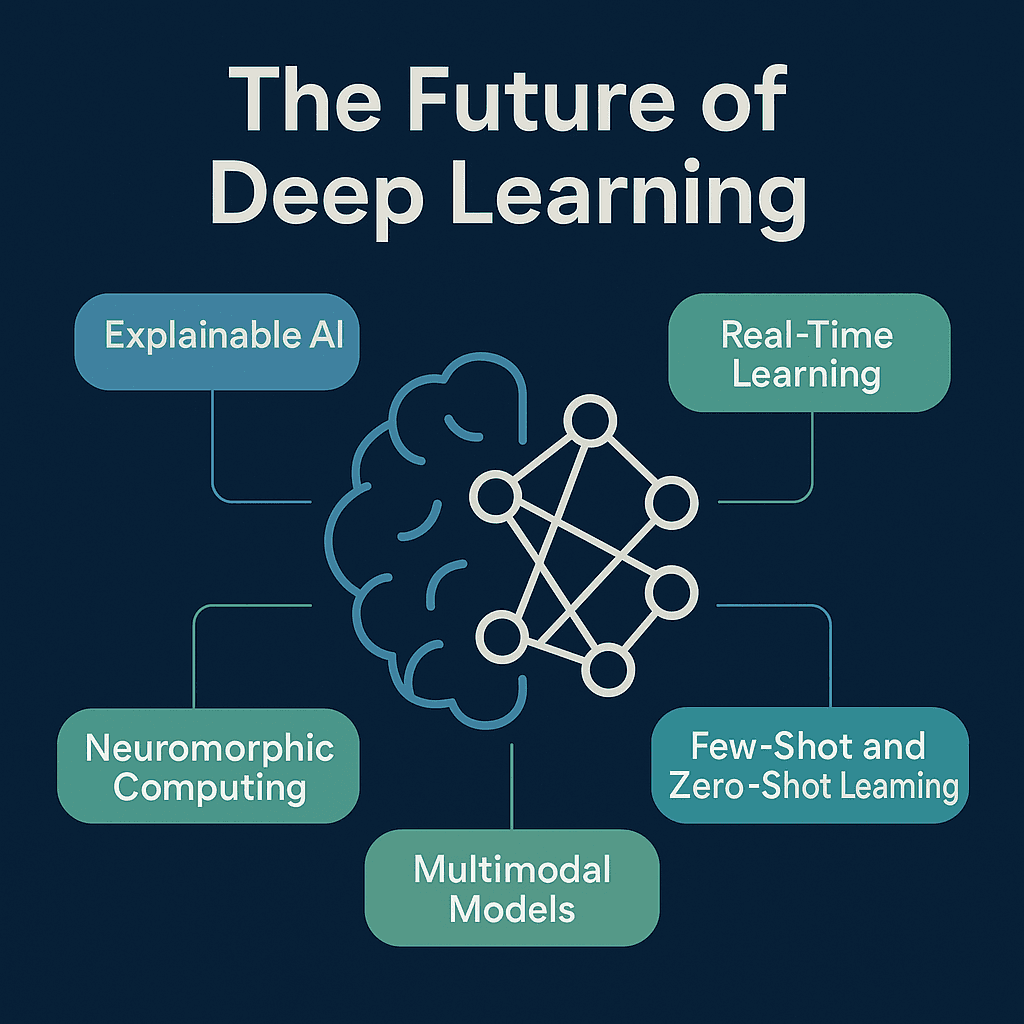
1. Explainable AI (XAI): No More Black Boxes
One of the biggest criticisms of deep learning is that it’s a “black box”—we know it works, but we don’t always know how it works.
In the future, explainable AI will become a top priority. Researchers are working on models that not only predict but also explain their reasoning. This is especially crucial in areas like healthcare and law, where decisions can have serious consequences.
👉 Imagine an AI doctor not only detecting a disease but also clearly showing why it made that decision.
2. Real-Time Learning: Smarter, Faster, Now
Current deep learning models usually need huge datasets and hours of training before they can work. But future systems will learn more like humans—on the go.
Online learning: Models that keep learning as new data comes in.
Edge learning: AI that trains directly on devices like your phone, without needing to upload data to the cloud.
This means more privacy, less latency, and faster responses in real-world applications.
3. Neuromorphic Computing: Brain-Like Hardware
What if we could design hardware that thinks like the human brain?
That’s the idea behind neuromorphic computing—chips that mimic the brain’s neural structure. They consume way less power and process information more efficiently, making deep learning faster and more energy-friendly.
Companies like Intel and IBM are already building brain-inspired processors. In the future, this could completely change how we train and run deep learning models.
4. Multimodal Models: One AI, Many Skills
Traditionally, AI models are trained for one task—like recognizing images or understanding text. But the future is about multimodal AI—systems that combine text, images, audio, video, and more.
A great example is OpenAI’s GPT-4, which can understand both text and images. The next wave? AI models that can:
Watch a video
Understand the scene
Answer questions about it
Generate related images or text
All in one go. 🤯
5. Less Data, More Smarts: Few-Shot and Zero-Shot Learning
Deep learning used to need millions of labeled examples. Now, we’re moving toward models that can learn with very few examples—or even none at all.
This is game-changing for businesses and researchers who don’t have massive datasets. Few-shot and zero-shot learning will make AI more accessible, efficient, and adaptable to new situations.
Bonus: AI That Learns Like Humans
In the far future, we’ll see deep learning evolve into general intelligence—models that can reason, plan, imagine, and even reflect.
These “AGI” (Artificial General Intelligence) systems will not just follow instructions, but understand the why behind them—blurring the lines between human and machine intelligence.
Sounds sci-fi? Maybe. But it's getting closer every year.
Final Thoughts
Deep learning has already changed our lives—but the future holds even more mind-blowing potential. From brain-like chips and smarter learning to explainable models and multimodal intelligence, we're stepping into a world where AI becomes more human-like, helpful, and everywhere.
And the best part? You don’t need to be a genius to get involved. Start learning today, and you could be part of the future that’s shaping our tomorrow.
Written by Anish BR